The movie shows how knowing that something for sure is gonna happen, big money players can negotiate instruments that allow them to make much bigger returns than what one would expect. Let's see. Naively, if you know that the price is going to go down or up 5%, you can make 5% returns. If you find a way to borrow money at a rate <5% of interest payments for that period of time, then you can increase your returns. The typical rate for a trustworthy borrower is 5,69% per year. If you know about 5% price move that's gonna happen over 1/2 a year, then you should borrow as much money as they are willing to lend you and get roughly 4% of that after all. Unfortunately, there's not so many places you can borrow big sums of money for stock market purposes. Maybe it changes when you have a lot of money already, and some legal status, Idk. But in essence, one would not expect that a hedge fund can borrow much more money than what investors already gave to it, or else it would do it all the time. So naively you expect that your returns will still be of order 5% of what your investors gave you, even if you are a hedge fund.
But there are plenty of financial instruments that circumvent it, most of which are not available to simple people. One thing would be leverage. As far as I understand, hedge fund can make an agreement with a broker about investing money 1:20 into this opportunity. Then, if the actual price reaches -5% at any point in that 1/2 a year, hedge fund loses everything. But if it actually goes +5% as expected, hedge fund doubles the money, getting +100% out of known 5% change of a given instrument. Another way of thinking about it: hedge fund finds a person who is willing to make a bet on all this money that the price is not gonna go move 5% that direction.
So when one of the main characters (played by Christian Bale?) was drawing numbers on the board: first -119% when the price did something unexpected, but then +440% when it went the way he expected, this is essentially what was happening. The housing prices dropped, say by 60%, after rising by 30%, counting from the moment he shorted the housing market. His bare returns are +30%. If he used the leverage instrument, he needed 1:14 to get his 440%. So he could only afford prices going up by 1/14, or 8%. If they went 9%, he'd lose everything. How could he afford 30% rise on his leveraged short position? And still be only in -119%, not in -440% as the symmetry would suggest?
First of all, he did not put all of his fund's money into shorting the housing market. But that doesn't help: to have 440% returns, he needed to have -440% loss when the price went the opposite direction. Which would bust him. The resolution is that, first, even though the housing market that we see was down by 60%, he shorted some more extreme instruments that were down by almost 100%. Second, to short them, he used Credit Default Swaps, that has been around for decades, just that nobody thought of using them on a housing market.
It is good to note that he made his decision to trade based only only the publicly available information. Using insider's information about upcoming price motions to make money is something you can go to jail for.
Another concept that movie covers are CDO's: a packs of loans that are offered by a bank to investors to provide money for. The movie drives the point home that anyone who was working in the bank on getting those CDO's approved and sold insurance on them was acting completely irresponsible and should go to jail (although almost noone did).
Much blamed CDO's still exist, although in a heavily regulated fashion. Banks still don't do a proper investigation of individual borrowers. However there are web-based platforms Lending club and Prosper that do the bank's job of connecting capital and borrowers without "black boxing" where the money goes. Careful investors can review every single loan app. For big investors, there's even a startup Theorem LP, that's a third party optimization/machine learning that helps quickly scan all the loan requests for reliable ones. They managed to double the return of a naive investment.
Their fees are twofold: there's a 1% fee for putting money into account, and standard hedge fund 10% fee on profits. The minimum account value is 1M$. So essentially what this company is doing is what big banks failed to do during the 2008: carefully review each loan application. It also claims to sometimes provide liquidity to those who want to withdraw (option not available to regular investors on Lending Club), and identify recession years and be even more stringent in the screening during those years. The defaults usually lag 0.5 years behind the economy collapse. Here's a neat data visualization by Bloomberg.
But there are plenty of financial instruments that circumvent it, most of which are not available to simple people. One thing would be leverage. As far as I understand, hedge fund can make an agreement with a broker about investing money 1:20 into this opportunity. Then, if the actual price reaches -5% at any point in that 1/2 a year, hedge fund loses everything. But if it actually goes +5% as expected, hedge fund doubles the money, getting +100% out of known 5% change of a given instrument. Another way of thinking about it: hedge fund finds a person who is willing to make a bet on all this money that the price is not gonna go move 5% that direction.
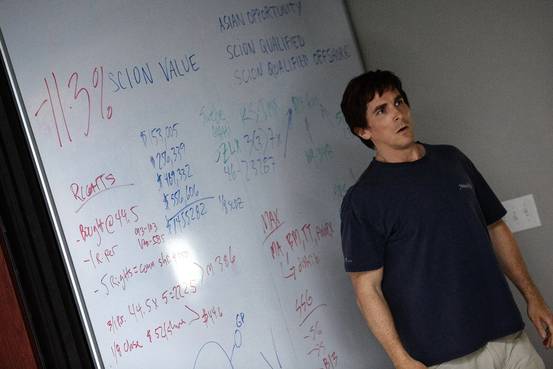 |
So when one of the main characters (played by Christian Bale?) was drawing numbers on the board: first -119% when the price did something unexpected, but then +440% when it went the way he expected, this is essentially what was happening. The housing prices dropped, say by 60%, after rising by 30%, counting from the moment he shorted the housing market. His bare returns are +30%. If he used the leverage instrument, he needed 1:14 to get his 440%. So he could only afford prices going up by 1/14, or 8%. If they went 9%, he'd lose everything. How could he afford 30% rise on his leveraged short position? And still be only in -119%, not in -440% as the symmetry would suggest?
First of all, he did not put all of his fund's money into shorting the housing market. But that doesn't help: to have 440% returns, he needed to have -440% loss when the price went the opposite direction. Which would bust him. The resolution is that, first, even though the housing market that we see was down by 60%, he shorted some more extreme instruments that were down by almost 100%. Second, to short them, he used Credit Default Swaps, that has been around for decades, just that nobody thought of using them on a housing market.
It is good to note that he made his decision to trade based only only the publicly available information. Using insider's information about upcoming price motions to make money is something you can go to jail for.
Another concept that movie covers are CDO's: a packs of loans that are offered by a bank to investors to provide money for. The movie drives the point home that anyone who was working in the bank on getting those CDO's approved and sold insurance on them was acting completely irresponsible and should go to jail (although almost noone did).
Much blamed CDO's still exist, although in a heavily regulated fashion. Banks still don't do a proper investigation of individual borrowers. However there are web-based platforms Lending club and Prosper that do the bank's job of connecting capital and borrowers without "black boxing" where the money goes. Careful investors can review every single loan app. For big investors, there's even a startup Theorem LP, that's a third party optimization/machine learning that helps quickly scan all the loan requests for reliable ones. They managed to double the return of a naive investment.
Their fees are twofold: there's a 1% fee for putting money into account, and standard hedge fund 10% fee on profits. The minimum account value is 1M$. So essentially what this company is doing is what big banks failed to do during the 2008: carefully review each loan application. It also claims to sometimes provide liquidity to those who want to withdraw (option not available to regular investors on Lending Club), and identify recession years and be even more stringent in the screening during those years. The defaults usually lag 0.5 years behind the economy collapse. Here's a neat data visualization by Bloomberg.
